

Finance
The Finance section of the sidebar opens the finance overview. The tabs at the top lead to Expenses, Billing, Contractors, Budgets and Profitability; More holds Rate cards, Accounting exports, Periods and Settings.
You only see the pages you are allowed to open; the link and the page check the same permission. Permissions from your roles and from permission sets assigned to you are counted together, and contractor accounts only get permissions open to external users. By default organisation owners and administrators can read finance data, except employee cost rates. Adding or changing records needs the matching permission, and every save asks for a reason.
Finance overview
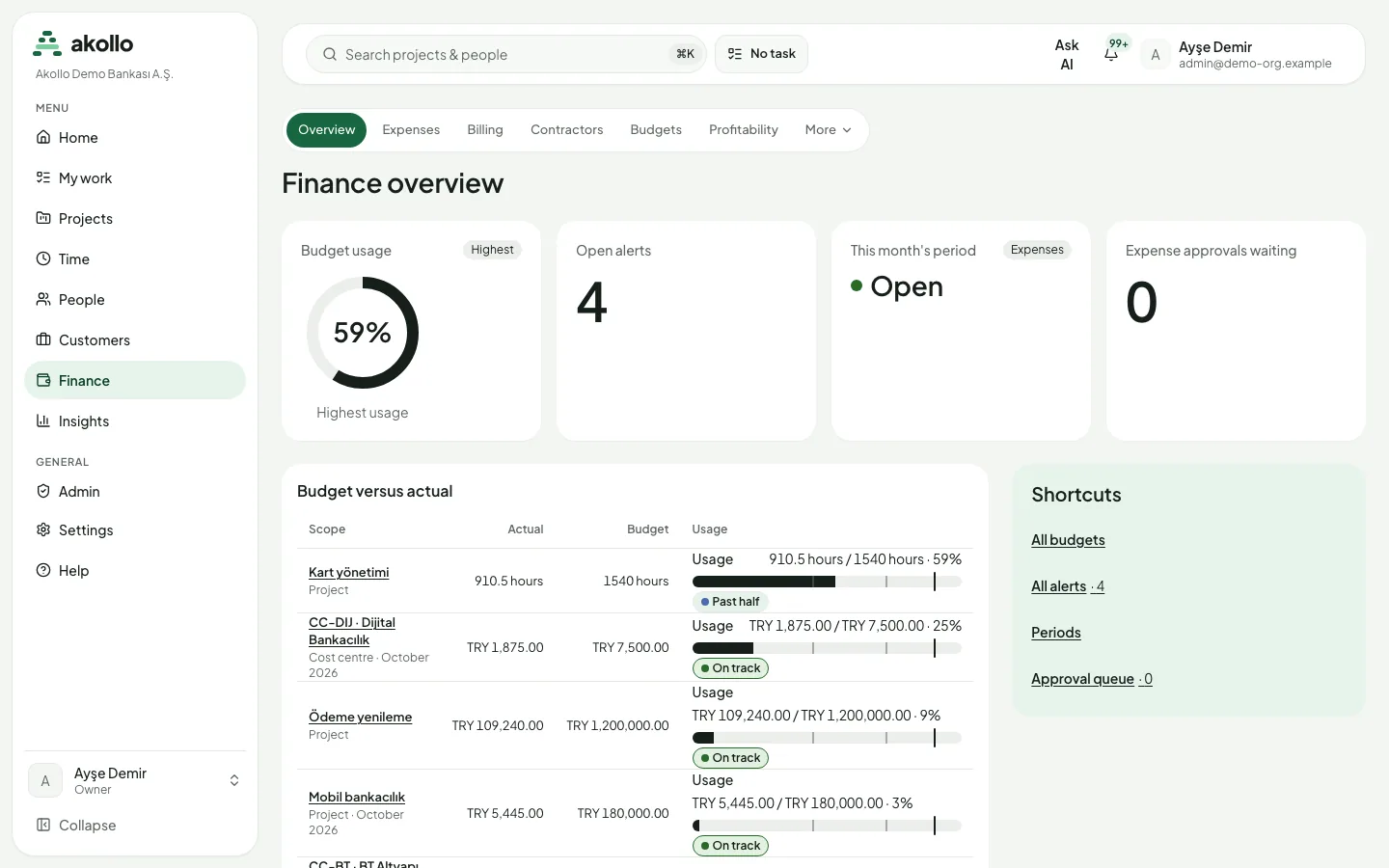
Finance overview brings the key figures together on one page:
- Budget usage: the highest usage among your budgets.
- Open alerts: budget alerts that are still open.
- This month's period: whether the current month is open, for example for the expenses ledger.
- Expense approvals waiting: how many expenses wait for a decision.
- Budget versus actual: each budget scope with its actual, budget and usage, and a tag such as On track or Past half.
Shortcuts lead to all budgets, all alerts, periods and the approval queue.
Expenses
The Expenses tab has three views: My expenses, Expense approvals and Reimbursements. My expenses lists your own expenses with date, merchant, category, amount, whether a receipt is attached, and status. Amounts are kept exactly as you type them; nothing is rounded on the way.
Record an expense
Open the form
Choose New expense on the Expenses tab.
Fill in the details
Enter the date, merchant, category, amount and VAT amount, and the currency (your organisation's base currency by default). Add the merchant's tax number, how you paid and whether the expense is billable.
Save the draft
Save the form. The expense is kept as a draft. While it is a draft you can edit or delete it.
Attach the receipt
Attach the receipt as JPEG, PNG, HEIC or PDF, up to 10 MB. If the same receipt was already used, you see a warning, and when you send the expense you are asked why.
Send it for approval
Send the expense for approval. From then on it is read-only.
A support session can look at the page but cannot change anything.
Expense approval
A submitted expense goes through an approval chain: your manager, then finance. The cost centre's owner approves between them when the amount is above the limit your organisation sets (10,000 TRY by default) or the currency is not Turkish lira. Approvers find their queue under Expense approvals.
Rules that apply to every chain:
- Nobody approves their own expense.
- The same person cannot approve two steps in a row.
- If no approver can be found (for example because the reviewing unit is not set), the expense is not sent and you see a message saying so.
- If you change a draft after sending it, it needs a fresh approval. An earlier approval never covers changed content.
Reimbursement
An approved expense you paid yourself follows one path, shown under Reimbursements: scheduled for payment, then paid. Paid is final. Company-card expenses are never reimbursed.
| Status | Meaning |
|---|---|
| Approved | The approval chain is complete. |
| Payment scheduled | The payment is planned. |
| Payment failed | The payment did not go through; the expense is scheduled again. |
| Paid | The employee has been paid. This status is final. |
Nobody who approved the expense, and not the employee, can schedule or confirm the payment.
Budgets
A budget belongs to a project, a department or a cost centre. Its basis is hours, cost or revenue. Hours are entered as a decimal; cost and revenue in the currency's major units.
Create a budget
Start a new budget
Choose New budget on the Budgets tab.
Choose scope and basis
Pick the scope (project, department or cost centre) and the basis: hours, cost or revenue. Choose the currency.
Set the amount and overrun rule
Enter the amount as a single total or as monthly lines. Choose whether an overrun only warns or blocks new commitments. Save with a reason.
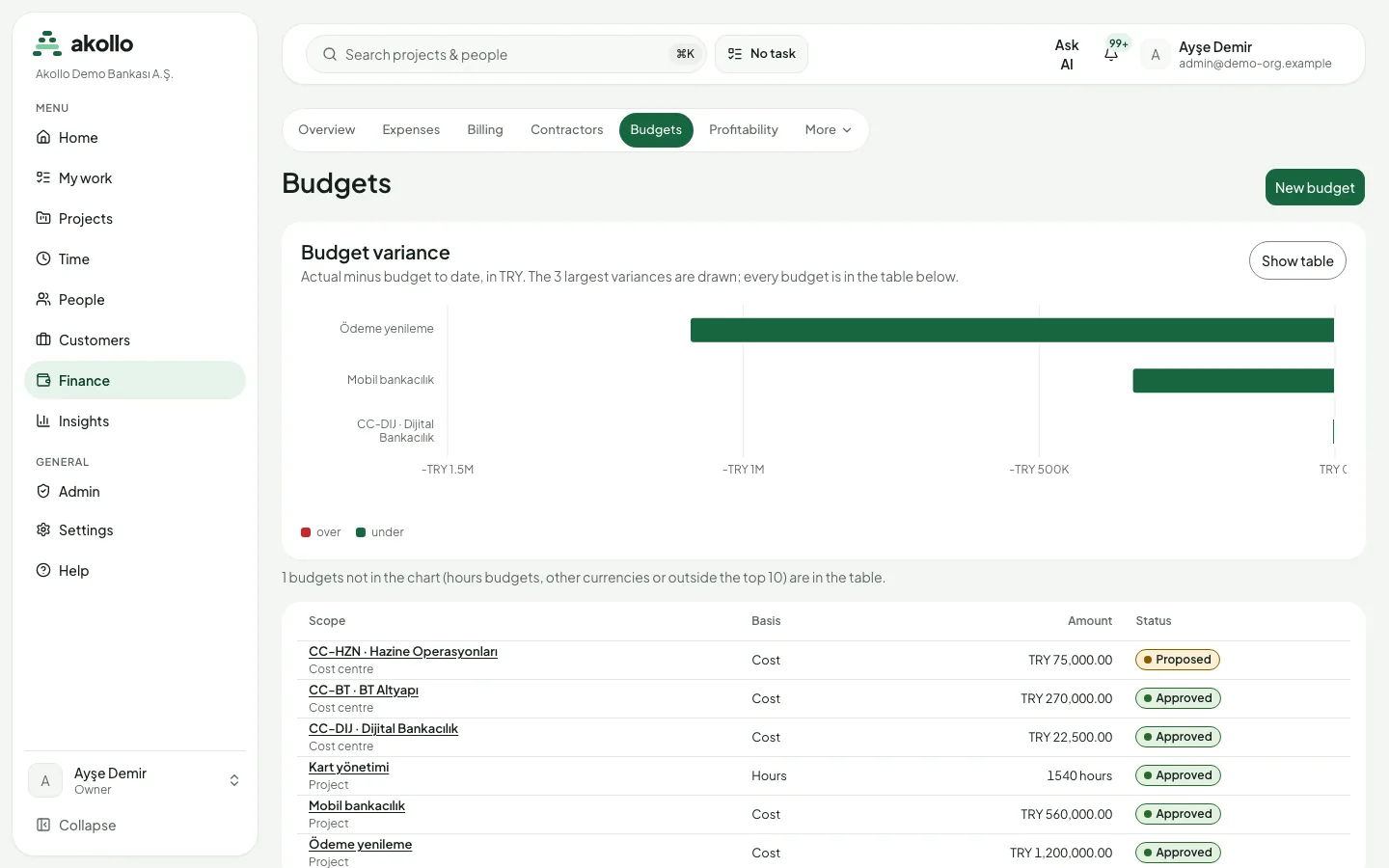
Every change is a new revision with a number and a status: proposed, approved or superseded. A revision that changes the last approved total by more than ten percent must be approved by someone other than the person who proposed it. Approving a later revision closes the open proposals before it. After approval the subject, basis and currency stay as they are.
The Budget variance chart shows actual minus budget to date. It draws the largest variances; every budget is in the table below it. A budget's page shows its usage, its revisions, budget versus actual and its alert history.
Profitability
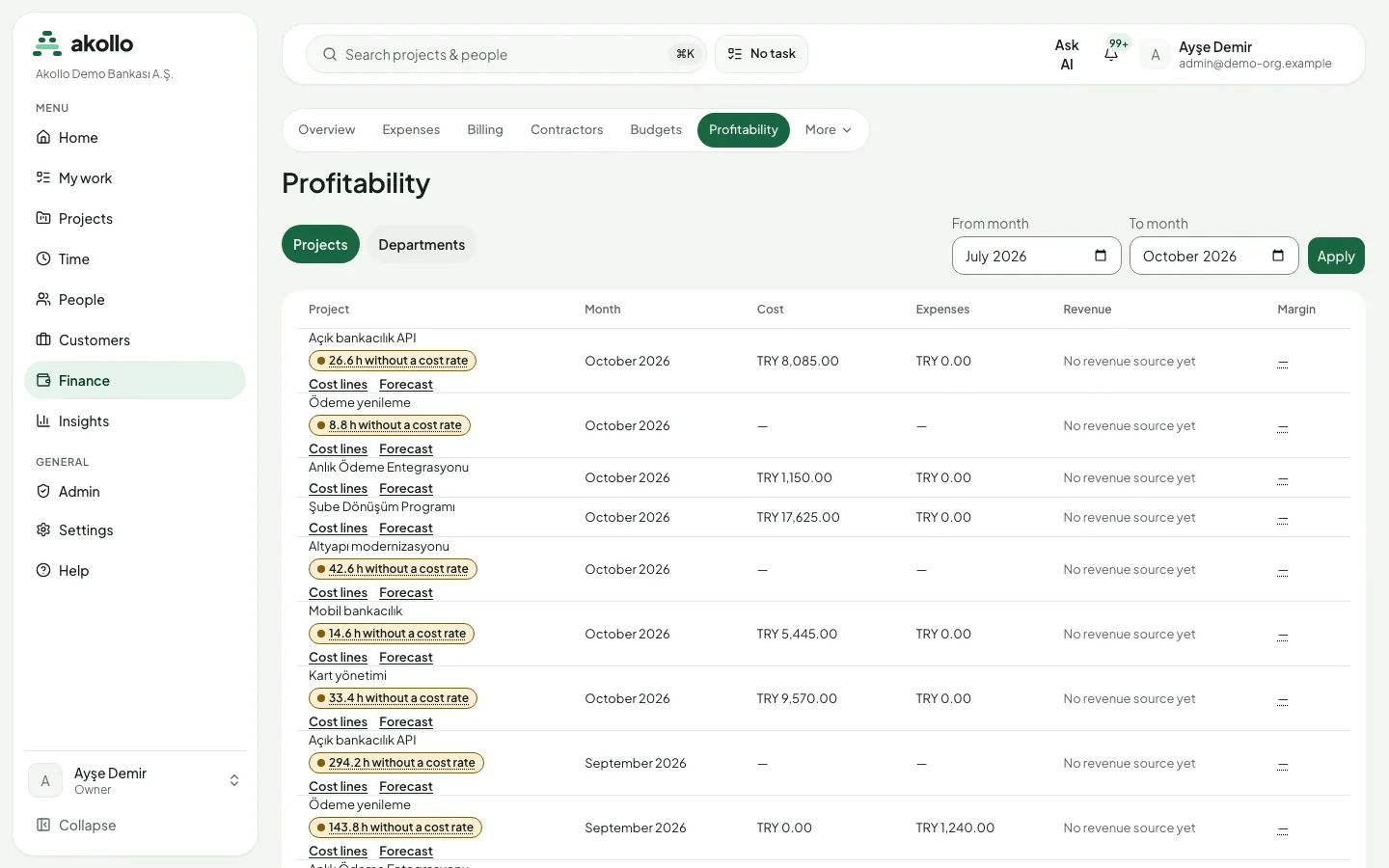
Profitability shows cost, expenses, revenue and margin per month, for Projects or for Departments. Choose a From month and a To month and select Apply. Hours without a cost rate are marked on the row; they are left out of the cost instead of counting as zero. Each row links to its Cost lines and a Forecast.
Billing and contractors
Billing holds invoices, credit notes and billing plans. Invoices move through the statuses draft, in review, approved, issued, sent, partly paid, paid and void; New invoice draft starts one. Contractors holds engagements with their hour and amount caps and hourly cost, supplier invoices and matching.
Rates
Rate cards hold billing rates for the organisation, a customer, a project, a role, a task type or an employee, each with its own dates, per hour or per entry. For a piece of work the most specific line applies, in this order: employee, task type, role, project, customer, organisation. If two lines tie, no rate is chosen.
A new card, adding or removing lines, or changing rates by more than ten percent in total since the last approval waits for another person to approve it. After you save, the page tells you whether the change is in effect or waiting. Only someone else sees the Approve button.
Cost rates (Rates → Cost rates) are hourly employee costs. They count as salary information and need a separate permission; owners and administrators do not get it automatically. You propose a rate for a date range and another person approves it. An approved rate is not edited: propose a new range, and when it is approved the previous rate ends on that date. People are shown by name.
Periods
Finance records are grouped into monthly periods per ledger: expenses, sales, purchases, tax and cost. The Periods page lists the months of each ledger with their status, such as open, soft locked or reopen requested, and a Manage action.
- A month can be locked temporarily, and closed after it has ended.
- A closed month is reopened only when one person asks and another approves. A reopen request can be withdrawn and lapses after 30 days.
- A hard-lock date can only move forward.
- A record dated in a closed month, or before the hard-lock date, is not saved. A temporarily locked month accepts records only from people allowed to override the lock.
- By default a cost or sales period can only close after the matching time period is locked. An administrator can turn this rule off.
These actions are also available through the API.
Settings
Finance settings link to four lists. Each shows its records, marks inactive ones, and lets people with the manage permission add or edit a record.
| List | Fields |
|---|---|
| Cost centres | Code, name, active period, parent cost centre, department and owner |
| Number series | Document kind, prefix and year |
| Expense categories | Code, Turkish and English name, unit, threshold and whether the category is active |
| Tax codes (VAT) | Code, rate and the date it applies from |
FAQ
After you send an expense for approval it is read-only. Only drafts can be edited or deleted.
When the amount is above the limit your organisation sets (10,000 TRY by default) or the expense is in a currency other than Turkish lira. The cost centre owner approves between your manager and finance.
No approver could be found for one of the steps, for example because the reviewing unit is not set. You see a message saying so. Ask your administrator to complete the setup.
Hours without a cost rate are left out of the cost instead of counting as zero. The profitability row shows how many hours have no cost rate.
Only people with the separate cost-rate permission. Owners and administrators do not get it automatically.